Story
Henry Senn headed a household in Lexington District, South Carolina, at every census from 1810 to 1840. An abstract of a Lexington deed, quoted on his FamilySearch profile, has him selling 180 acres on Twelve Mile Creek to Adam and David Cromer in July 1822, with his wife Nancy giving up her right of dower. A deed of January 1845 names him as the father of Daniel, Lemuel, Matilda and Margaret Senn: Abram Geiger had given a tract of 230 acres on the south branch of Congaree Creek to the four of them and “their Father Henry Senn.” Why a Geiger gave the family land is not said; Nancy may have been a Geiger, and the FamilySearch tree calls her Nancy Ann Geiger, citing a Lexington genealogy newsletter rather than a record.
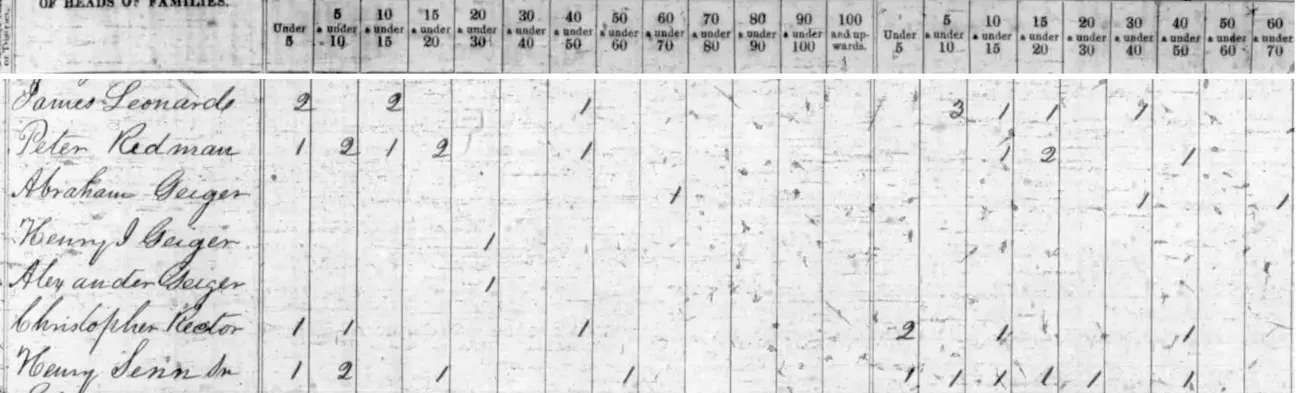
The census taker of 1840 listed him as Henry Senn Sr., a man in his fifties, so born between 1780 and 1790, living among the very neighbours who appear in Lemuel’s deeds: Abraham, Henry J. and Alexander Geiger, James Leonard, Peter Redman and George Scott. A Daniel Senn, likely his son, headed a household two pages on. Henry was still living in December 1841, when he witnessed the papers that divided Abram Geiger’s estate among his widow and children.
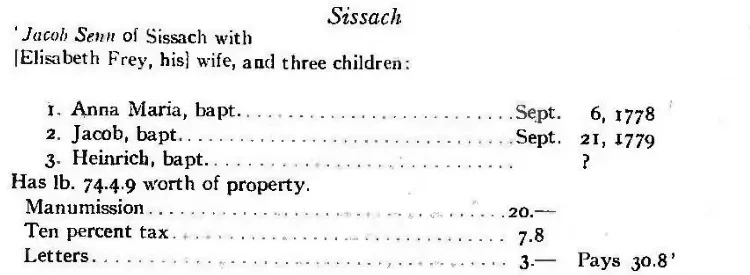
He may have been born in Switzerland. On March 8, 1788, the government of Basel released five families to emigrate to America, and one of them was “Jacob Senn of Sissach” with his wife Elisabeth Frey and three children: Anna Maria, Jacob and Heinrich. The church book of Sissach records the baptism of Heinrich, son of Hans Jakob Senn and Elisabeth Frey, on August 7, 1785; he had been born three days before. Two years after they left, the 1790 census found a Jacob Senn heading a household in the north part of Orangeburgh District, the part that became Lexington District, with two boys under sixteen; and in 1810 Jacob Senn and Henry Senn were both heads of households in Lexington. No record found so far says outright that the Henry of Lexington was the boy from Sissach. The dates fit, and Heinrich is simply the German for Henry, but there is another candidate: a Henry Senn living in Harrison County, Indiana, in 1850 gave his age as 65 and his birthplace as Germany, and his wife had been born in Pennsylvania, where most Swiss emigrants of 1788 landed. Until a record names the Lexington Henry’s father or birthplace, the Swiss line stays a possibility.
The Swiss Senns of the Carolina backcountry came from the same few villages of the Basel countryside. In 1735 and 1736 several Senn families of Tecknau, a hamlet a few miles up the valley from Sissach, were released to go to Carolina, all three too poor to pay the usual dues: Hans Jacob Senn and Ursula Dörfflinger, with Martin, baptized in 1717, and Margaret, 1720; Heini Senn and Madle Handschi, with Elssbet, 1726, Verena, 1727, and Martin, 1729; and Heini Senn and Maria Tschudi, with Mattis, 1730, Elssbet, 1732, and Anna, 1734. Mattis is very likely the Mathias Senn who claimed 300 acres on the Saluda in 1775 and served in South Carolina during the Revolution. A second Sissach family, Hans Jacob Senn and Barbara Seiler, left in April 1772 with two sons, Heinrich, baptized in 1766, and Johannes, baptized in 1769. Where they settled is not recorded in the Swiss list.
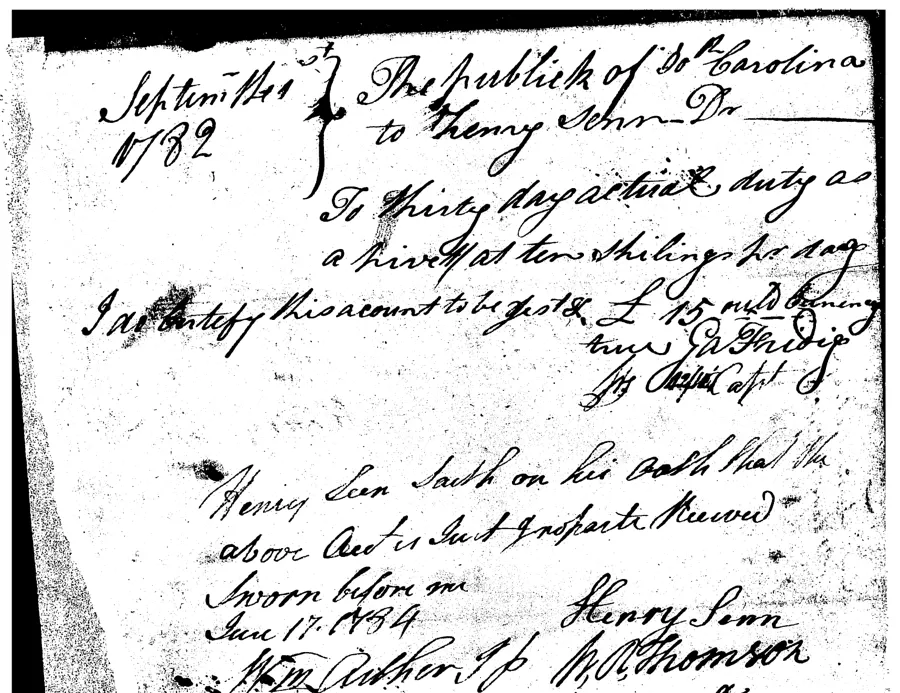
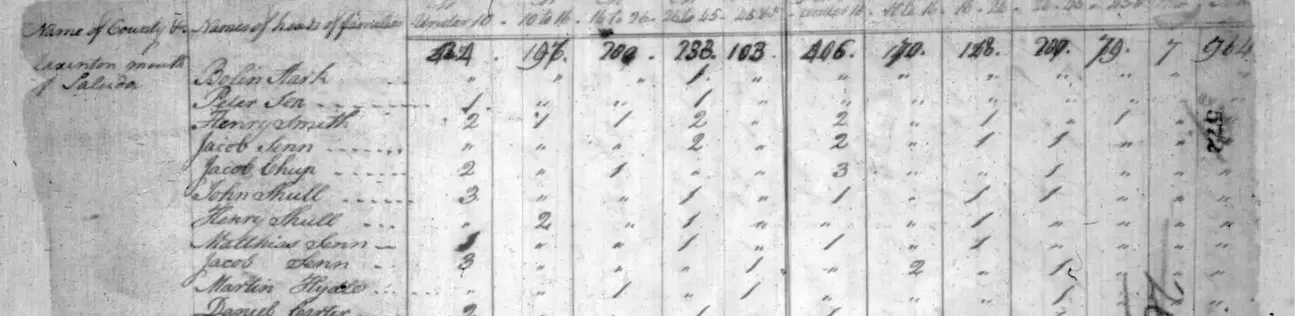
Three records from South Carolina itself now point at that 1772 family. The state’s files of Revolutionary claims hold the account of a Henry Senn who served thirty days as a private in the militia in 1782, certified by a Captain Friday and sworn in 1784 before William Arthur, a justice whose family lived beside the Senns near the Saluda; Henry signed it himself. That Henry was a grown man by 1782, as the Heinrich born in 1766 would have been, so he cannot be the Henry of the 1840 census, who was born in the 1780s, but he may well be his father or an older brother. In 1790 a Barbarah Senn, plainly a widow, headed a household beside Jacob and Mathias Senn, with one man, two boys under sixteen and three women and girls; Barbara Seiler was the mother of the 1772 family. And in 1800 the census taker listed Peter, Jacob, Matthias and another Jacob Senn together at the mouth of the Saluda, but no Henry, and not one of those households held a boy of ten to sixteen, the age the 1788 Heinrich of Sissach would have been. His children later said he was born in South Carolina.
Put together, the likeliest reading is that Henry was born in South Carolina in the 1780s to the 1772 family, perhaps to the militiaman Henry or to Barbara, rather than being the boy brought over in 1788. None of this is proven: no record yet names his parents.
If Henry was the boy from Sissach, the FamilySearch tree carries his line back nine more generations, and most of it stands on the Sissach church books. His father would be Hans Jakob Senn, who had children there by three wives, the last of them Elisabeth Frey; their children were baptized in 1778, 1779, 1782 and 1785, and the first Heinrich, born in 1782, was buried in 1784, which is why the second was given the same name. From there the tree runs: Hans Jakob Senn, baptized 15 January 1726, son of Heinrich (Heini) Senn and his wife Sara, called Sara Strub on the tree though the indexes read her surname differently; Heinrich, baptized 14 June 1692, son of Jacob Senn and Anna von Arx; Jacob, baptized 26 February 1660, son of Jacob Senn and Anna Imhof; Jacob, baptized 15 November 1635, son of Johannes (Hans Jacob) Senn and Maria Hagler; Hans Jacob, baptized 12 November 1615, son of Jacob Senn and Barbara Scherer; Jacob, baptized 22 October 1592, son of Hans and Ursula Wisser; Hans Sehn, baptized 5 January 1567, son of Isaac Sehn and Elsbeth Stähel; and Isaac, born about 1538, the earliest of the name in the Sissach books. Above Isaac the tree has only a man called Sehn, born about 1500, with no record behind him. Each of those baptisms names the parents, so each step is backed by a record. Two places need care. The tree gives Hans Jakob, the 1788 emigrant, a baptism of 2 November 1752 as a son of the Hans Jakob born in 1726 and Anna Maria Keyser, but no such baptism is in the indexes or attached to his profile, and Sissach had several men of that name at once, one of them buried there in 1800. And the whole line hangs on the step from Sissach to Lexington, which is the part this page has not been able to prove. So the Swiss line is shown here as the tree’s, not yet as the family’s.
Sissach is a market village in the hills south-east of Basel, in the valley of the Ergolz. Its parish books go back to the 1500s, which is why the line can be followed so far.